
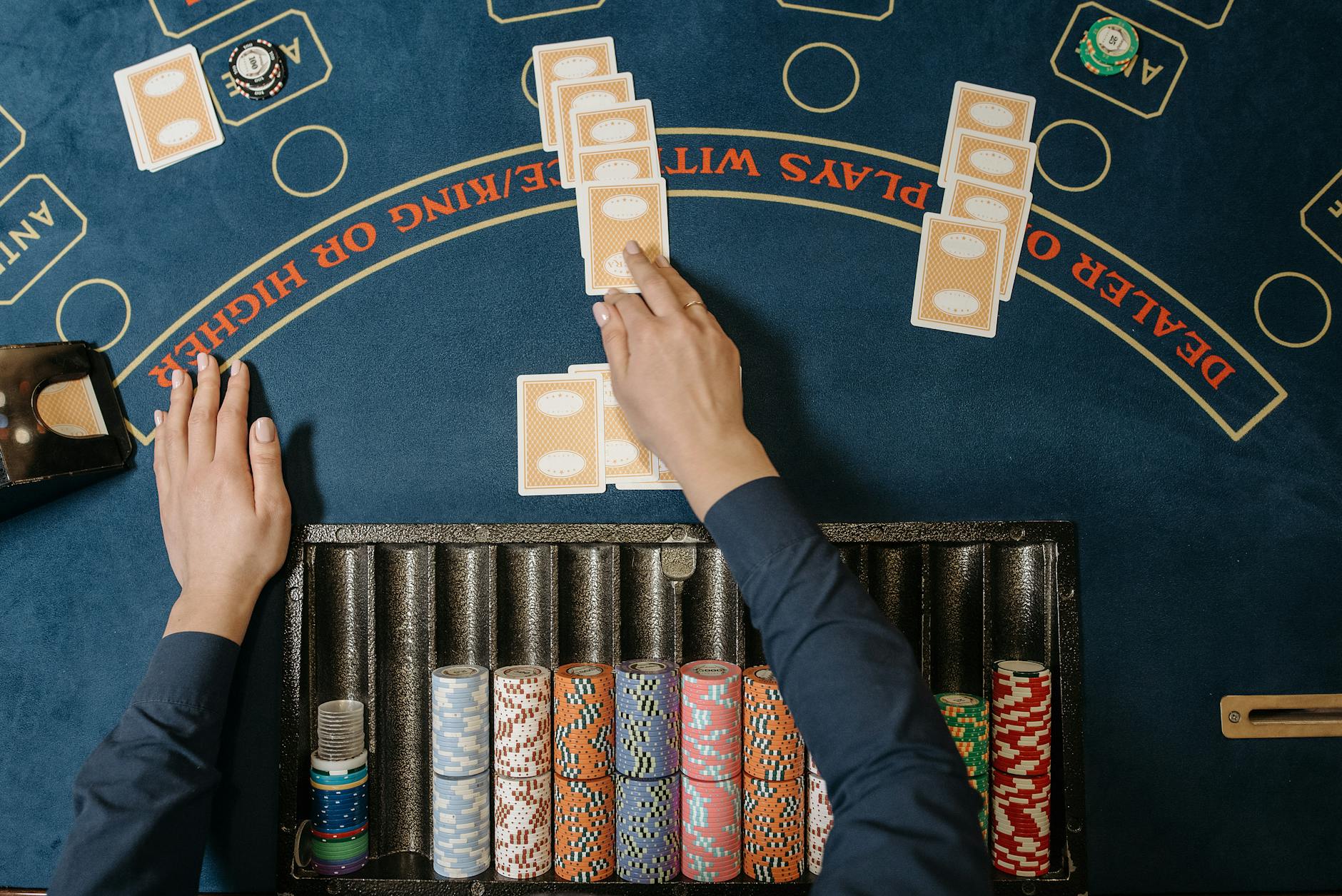
Blackjack is the only standard casino table game where the decisions you make at each hand measurably change the house edge. Slot players can't do that. Roulette players can't either. In blackjack, a player using correct basic strategy faces a house edge below 0.5% on the best-paying variants. A player guessing produces something closer to 2% to 4%. That gap is real, and it's why blackjack attracts serious players.
This guide covers how online blackjack works, which variants you'll find at US-facing casinos, where the house edge comes from, and what decisions actually matter. It won't sell you a betting system that beats the math. No such system exists.
The core rules of blackjack
The goal of blackjack is to beat the dealer by holding a hand value closer to 21 without going over. Number cards count at face value. Face cards (Jack, Queen, King) count as 10. An Ace counts as 1 or 11, whichever helps the hand.
A "blackjack" is an Ace plus any 10-value card dealt as the first two cards. It typically pays 3:2, which is better than the standard 1:1 even-money payout for other winning hands. Some casinos pay 6:5 on blackjack instead. That single rule change raises the house edge by about 1.4 percentage points. Avoid 6:5 tables when you can.
Each hand starts with the player and dealer each receiving two cards. One dealer card is face-up; the other is face-down (the "hole card"). The player then decides how to act:
- Hit: take another card.
- Stand: keep the current hand.
- Double down: double the bet and receive exactly one more card.
- Split: when holding two cards of the same value, split them into two separate hands, each with its own bet.
- Surrender: available at some tables; forfeit half the bet rather than play out a bad hand.
After the player acts, the dealer reveals the hole card and must hit until reaching 17 or higher. In most variants the dealer stands on all 17s, but some games use a "soft 17" rule where the dealer hits a soft 17 (Ace + 6). Dealer hitting soft 17 adds roughly 0.22% to the house edge.
Where the house edge comes from
Blackjack's house edge doesn't come from rigged cards. It comes from one structural rule: the player acts first. If a player busts (exceeds 21), the bet is lost immediately, even if the dealer would have busted too. That sequencing gives the house its edge.
Everything else in the ruleset modifies that base edge up or down. As explained in Casino RTP and house edge explained, RTP and house edge are two sides of the same figure: a 99.5% RTP game has a 0.5% house edge. In blackjack, the exact edge depends on:
- Blackjack payout (3:2 vs 6:5).
- Number of decks in the shoe (fewer decks favor the player slightly).
- Dealer soft 17 rule (hit or stand).
- Whether doubling after splitting is allowed.
- Whether surrender is available.
- How many times you can split Aces.
A single-deck game with 3:2 payouts, dealer stands on soft 17, and full doubling rules can produce a house edge under 0.15% with perfect play. A six-deck shoe with 6:5 payouts and dealer hitting soft 17 can push above 2%. Both are called "blackjack." They're not the same game.
Basic strategy: what it is and why it matters
Basic strategy is a mathematically derived decision chart that tells you the optimal play for every hand combination against every dealer up-card. It was computed decades ago by simulating millions of hands and finding which decision produces the highest expected value in each situation.
Following basic strategy won't guarantee a win in any single session. Variance is real. But it eliminates the house's extra edge that comes from player error. The difference between guessing and using a strategy chart is consistently 1% to 2% of every dollar wagered. Over a long session, that compounds quickly.
Key basic strategy principles that players most often get wrong:
- Always split Aces and 8s.
- Never split 10s or 5s.
- Double 11 against a dealer's 2 through 10 (except Ace in some rule sets).
- Stand on hard 17 and above, always.
- Hit 12 against a dealer's 2 or 3.
Basic strategy charts are freely available and legal to reference while playing online. There's no reason not to use one.
Online blackjack variants at US casinos
Most US-facing online casinos offer at least 4 to 8 blackjack variants. The core rules stay the same, but side bets, deck counts, and payout structures change.
Classic blackjack uses 1 to 8 decks and typically offers the cleanest rules. It's the best starting point.
European blackjack differs mainly in that the dealer doesn't take a hole card until after the player acts. This changes doubling and splitting strategy in specific situations, because you risk losing a larger bet before knowing the dealer has a blackjack.
Blackjack Switch lets you play two hands simultaneously and swap the top cards between them. The catch: blackjack pays even money (not 3:2), and a dealer total of 22 pushes all non-busted player hands rather than losing.
Spanish 21 removes all four 10-value cards from the shoe (though face cards stay). Player-favorable rules like late surrender, re-splitting Aces, and bonus payouts compensate partially, but the missing 10s shift the edge significantly.
Perfect Pairs and 21+3 are standard blackjack games with optional side bets added. The side bets carry house edges in the range of 3% to 6%, well above the main game. They're entertainment, not strategy.
Live dealer blackjack streams a real dealer from a studio to your screen. Evolution Gaming and Ezugi supply most live blackjack tables at licensed US casinos. The rules are equivalent to RNG (random number generator) blackjack, but the format appeals to players who want a social experience closer to a physical casino table.
RNG vs live dealer blackjack
RNG blackjack uses certified random number generators to determine card order. Reputable operators use audited RNG software, and independent labs like eCOGRA or iTech Labs verify the outcomes. You play faster, the stakes can be lower, and you can pause mid-hand.
Live dealer tables run slower because they use real cards and a real dealer pace. Minimum bets are usually higher, often $5 to $25 per hand. The draw is authenticity: you can watch the cards being dealt rather than trusting software.
Neither format has a mathematical edge over the other if the same rules apply. Choose based on your preferred pace and stake level.
Blackjack and casino bonuses
Blackjack's low house edge makes it a common target for restricted game rules in casino bonus terms. Many bonuses exclude blackjack entirely from wagering contributions, or count blackjack wagers at just 10% to 20% toward the requirement. Before claiming a bonus at a casino you found through a site like Best online casinos in the USA, check whether blackjack wagers count toward clearing the promotion.
This matters because a 35x wagering requirement on a $100 bonus means $3,500 in total bets before you can withdraw. If blackjack contributes at 10%, you'd need $35,000 in blackjack hands to clear the same bonus. That's rarely worth it. The wagering requirements guide covers contribution rates in detail and shows how to calculate the real value of a bonus before accepting it.
What to look for in an online blackjack game
When choosing a blackjack table at a US online casino, check these five things before placing a bet:
- Blackjack payout: 3:2 is standard. Walk away from 6:5.
- Deck count: fewer decks is generally better for the player.
- Soft 17 rule: dealer stands on soft 17 is preferable.
- Double and split options: the more flexible, the better.
- Surrender availability: late surrender lowers the house edge by about 0.07%.
These details appear in the game's info or help screen at every reputable online casino. A game that hides its rules should be avoided. Good operators publish the full ruleset before you wager a dollar.
Responsible play in blackjack
Even with perfect basic strategy, blackjack has a house edge. It's small, but it means the expected outcome of long-term play is a loss. Short sessions with a pre-set loss limit are the only sensible approach. Set a budget before you sit down, and treat it as the cost of the entertainment rather than a recoverable investment.
Betting systems like Martingale (doubling the bet after each loss) don't change the house edge. They change the variance, and they expose players to rapid, large losses when a losing streak coincides with the table maximum. No betting sequence makes a negative expected-value game profitable over time.
US casinos licensed at the state level are required to offer responsible gambling tools including deposit limits, session timers, and self-exclusion. Use them if you need them.